
By Breaunna Alexander, Research Manager
Over the past decade, California has transformed higher education for students who are incarcerated by expanding access to in-person courses and offering associate’s, bachelor’s, and master’s degree opportunities for these students. The continued expansion of college programming for students who are incarcerated presents postsecondary staff, faculty, and administrators with an opportunity and responsibility to rethink how teaching and student supports operate within prisons, how new programs for students who are incarcerated are developed, and what key characteristics of these programs support students after their release. To examine these questions the CSU Student Success Network (“Network”) conducted the CSUs Supporting Justice-Involved Students study to explore the design, development, and process for facilitating postsecondary education opportunities inside California prisons and ultimately supporting students on their educational journeys after their release from prison.
This blog summarizes research on postsecondary education in prison settings, details the expansion of college programs in California prisons over the last decade, and presents key considerations for facilitating students’ learning while incarcerated. It concludes with a brief description of the methodology of the CSUs supporting Justice-Involved Students study and an outline of the forthcoming series of blogs detailing the study’s findings.
Postsecondary Education in Prisons Has Well Documented Benefits
The benefits of postsecondary education for students who are incarcerated are widespread. Postsecondary education in prisons positively impacts the individual student, both within and beyond incarceration. Prior work has revealed the positive effects of postsecondary education on lowering rates of re-incarceration– “as incarcerated people achieve higher levels of education, the likelihood of recidivism decreases” (Chesnut & Wachendorfer, 2021). Moreover, postsecondary education supports students throughout their career journeys.
- Students develop and strengthen both critical thinking and problem-solving skills through coursework and engagement with the curriculum.
- Postsecondary programs can connect to key workforce areas, such connections create a more direct path to employment for students who are formerly incarcerated.
Evidence indicates that postsecondary education contributes to overall safety in carceral facilities and has positive economic impacts. Fewer violent incidents occur in facilities with postsecondary education opportunities compared to prisons without these opportunities (Chesnut & Wachendorfer, 2021). When considering the fiscal impacts of higher education for currently incarcerated individuals, existing research has found that “every dollar spent on prison education programs results in four to five dollars saved in incarceration costs.”
Moreover, postsecondary education in prison further advances equity and progress towards racial justice. In California, Black and Hispanic individuals are overrepresented in the state’s carceral system. According to data presented by the Prison Policy Initiative in 2024:
- individuals who identify as Black non-Hispanic represent five percent of California residents, but over a quarter of the prison population (28%); and
- individuals who identify as Hispanic make up 40 percent of total California residents, and represent a slightly larger share of the total prison population (45%).
While California postsecondary education systems cannot change or affect these racial disparities within California’s carceral systems, expanding and supporting access to postsecondary education for individuals who are currently incarcerated can support these systems in furthering efforts to close equity gaps for minoritized students.
Postsecondary Education for Individuals who are Currently Incarcerated in California Prisons Has Expanded Over the Last Decade
Over the last 11 years, access to postsecondary education has expanded in California prisons. Policy changes have addressed students’ financial barriers to accessing courses and furthered opportunities for them to attend in-person classes. Partnerships between CDCR and California colleges and universities have expanded access to associate’s, bachelor’s, and master’s degrees for students who are currently incarcerated.
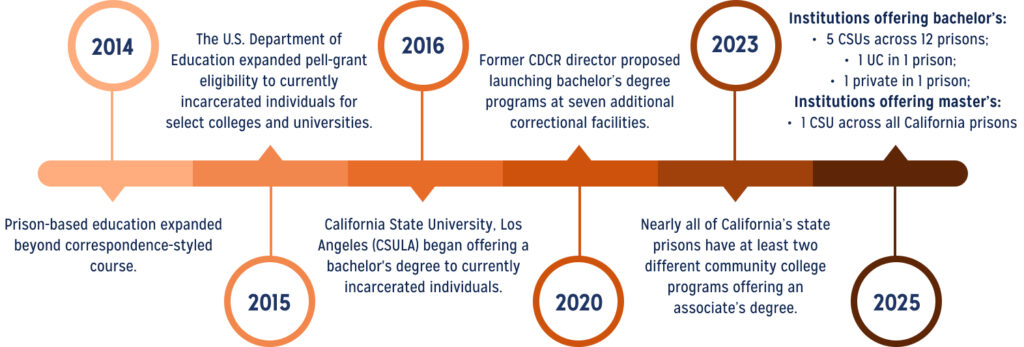
Legislative changes addressed financial barriers for colleges and students. Key legislation from 2014-15 provided incarcerated students the opportunity to attend in-person Community college courses, access Federal Pell Grants, and waive their tuition for enrollment in face-to-face California community college courses. In December 2020, the FAFSA Simplification Act, which went into effect fully in July 2023, restored Pell Grant eligibility to students currently incarcerated in California, effectively allowing low-income students who have not yet attained a bachelor’s or professional degree to use Pell Grant funds to cover academic-related materials and tuition.
Bachelor’s degree programs in prisons have expanded across the state. Bachelor’s degree programs started becoming available to individuals in California prisons in 2016, with California State University, Los Angeles (CSULA) being the first university to offer this type of educational opportunity to students in the state. According to an interview EdInsights conducted with then Director of Rehabilitative Programming for the California Department of Corrections and Rehabilitation (CDCR), CDCR was interested in expanding bachelor’s degree programs to additional California prisons by fall 2020, using the CSULA program as a model for these additional programs. While funding for this proposed expansion was removed from the Governor’s 2020-21 budget due to COVID-19 and subsequent budget cuts, bachelor’s degree programs at three additional correctional facilities were established after this initial proposal was withdrawn.
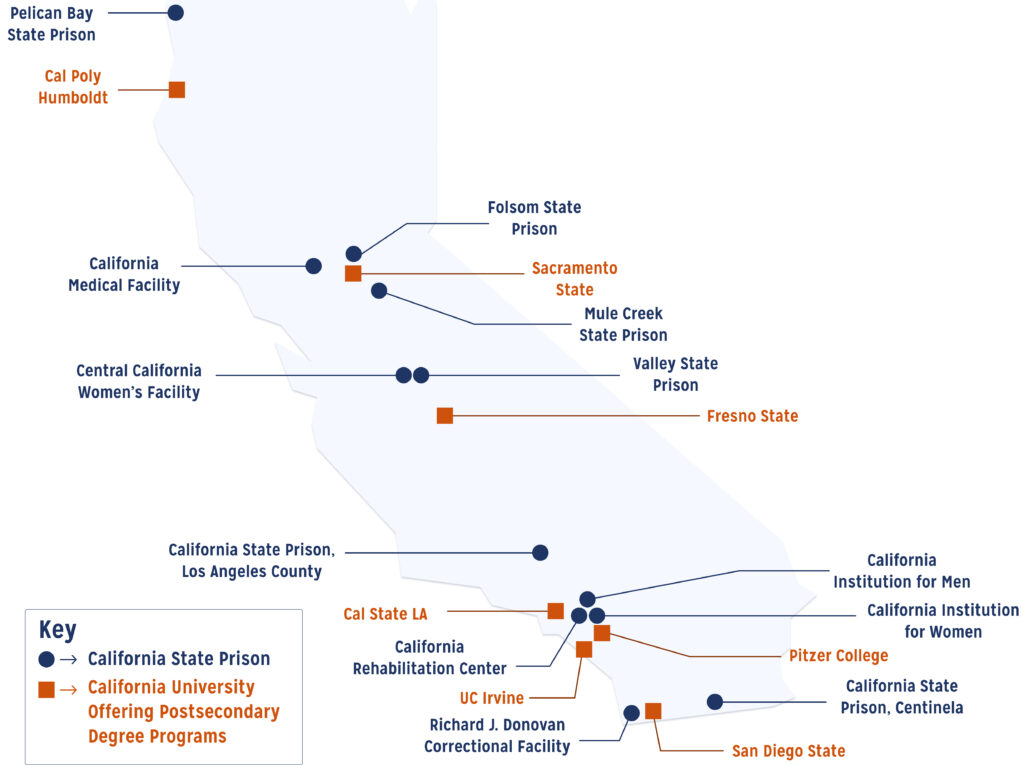
Postsecondary education is now widely available across California’s prison system, though associate degree programs are more common than programs offering bachelor’s degrees. Nearly all of California’s state prisons offer at least two different community college programs offering an associate’s degree. All California prisons have community college programs by correspondence or distance, with the majority of these institutions providing face-to-face college programs.1 Twelve prisons, across security levels and both women and men facilities, offer bachelor’s degree programs through various modalities. Finally, one CSU partnered with CDCR to offer a master’s degree to eligible individuals across all California prisons.
Seven California Universities Offering Postsecondary Degree Programs across 12 Prisons Statewide
Key Considerations for Facilitating Learning within and Beyond Prison Walls
The effectiveness of postsecondary prison programs is related to the unique structure, design, and approach to teaching that program faculty adopt. In order to most effectively support incarcerated students’ learning, faculty teaching inside of prisons must consider and attend to students’ lived experiences, the political and social context of the prison(s) in which they are teaching, and preparing students for release.
Understanding students’ lived experiences. Students’ backgrounds and lived experiences profoundly impact and influence their educational experiences. For students who are incarcerated, specifically, these differences in their characteristics (e.g., socio-economic backgrounds, remaining length of prison sentence, age, prior educational attainment and exposure) impact both their self-efficacy and motivation for pursuing postsecondary education. Understanding students’ prior educational exposure and experiences can support faculty in employing an individualized approach to designing and structuring their course and related-work, which can further support students’ academic success. Moreover, understanding and incorporating students’ backgrounds and interests into the course can both support students’ motivation to invest in their own education while also creating an environment that is attentive to students and creates opportunities for them to engage in learning.
Considering how prison restrictions and security affect course modality. While virtual learning has been an option for many postsecondary students, due to varied security restrictions and facility functions, virtual learning has not been readily accessible for students who are incarcerated. This, coupled with the movement restrictions that emerged in the wake of COVID-19, effectively stalled access to postsecondary education for many students inside prison. During the three academic semesters of 2020—spring, summer, and fall—approximately three-quarters of postsecondary programs offered in prison either modified their course delivery or terminated programming entirely (Chesnut & Wachendorfer, 2021).
Through interviews conducted by EdInsights with nine postsecondary program providers across various California community colleges, interviewees shared that there were no options for incarcerated students to engage in virtual learning, requiring in-person programs to pivot to a correspondence-based learning model in which students independently completed course packets. Interviewees said that courses that were difficult to transform into a packet-based learning model were terminated for the time being, which effectively delayed students’ academic progress. The experiences of coordinating and navigating these barriers to in-person programming provided a foundation for furthering conversations about using technology as a mode for course delivery as well as a communication tool between students and their professor(s). Further, understanding that each prison has a unique set of expectations and policies related to technology as a mode of delivery and communication tool is particularly important, as these variations impact how postsecondary program personnel may need to adapt their course delivery and expectations to align to the various prisons that they may teach in. Overall, expanding the use of technology in postsecondary programs within prisons can better safeguard against disruptions to students’ academic progress.
Supporting students in continuing postsecondary education post-release. Unique to students who are incarcerated is that planning to continue their postsecondary education following their release from prison is a component of planning for reentry, which means these students must also plan for and consider parole implications, housing, and transportation, all while dealing with course and program availability. Across postsecondary institutions in California, there are supports designed specifically for formerly incarcerated students that provide both academic and social support services to aid these students in navigating reentry (e.g., course advising, enrollment support, transportation). Systemwide programs, including Rising Scholars Network within the California Community Colleges; Project Rebound within the CSUs; and the Underground Scholars Initiative of California (such as the one at UC Berkeley), are often a source of centralized resources and support for justice-involved2 students within these education institutions.
New Study: CSUs Supporting Justice-Involved Students
While prior research documents the benefits of postsecondary education for incarcerated students, as well as the promising growth in programs across the state, faculty and staff are often left with limited guidance on how to translate this evidence into practice. Questions remain about what colleges are doing on the ground, what challenges practitioners face, and which approaches to program design and implementation show promise for serving students inside prison. To help address some of these questions, the Network conducted interviews with CSU personnel from both the bachelor’s degree programs and Project Rebound.
These interviews revealed the complex and intricate nature of cross-agency, student-centered efforts. The efficiency and effectiveness with which universities support justice-involved students is intricately tied to the strength of internal and external partnerships. The findings highlighted through this study could also be applied to further student-centered support for students from other minoritized backgrounds. The key study findings related to opportunities for strengthening and furthering cross-agency partnerships will be disseminated solely through a series of three blogs exploring:
- experiences and lessons navigating collaboration within institutions,
- experiences and lessons navigating cross-institution partnerships, and
- practical strategies and resources for supporting partnerships and students’ success.
1 The total number of California prisons fluctuate across years due to closures and planned developments.
2 Refers to students who have been impacted by or involved with the legal system at any point in their life.