
By Breaunna Alexander, Research Manager, EdInsights
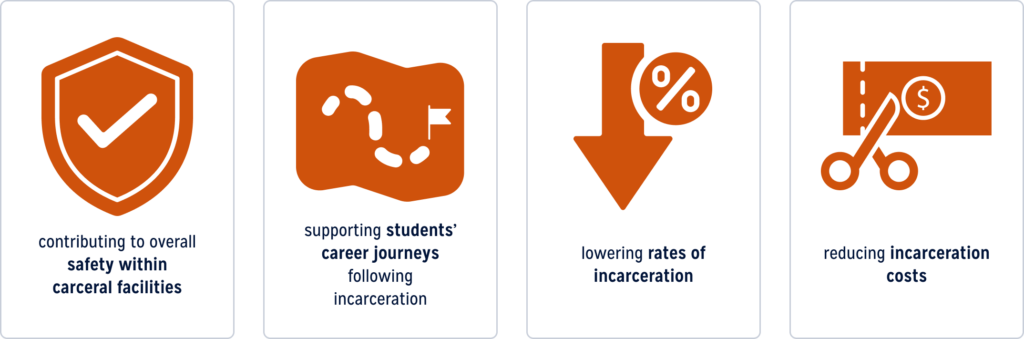
The landscape of postsecondary education for currently incarcerated students has evolved over the last decade, expanding access to associate’s, bachelor’s, and master’s degrees for these students. The continued expansion and innovation of postsecondary programming in and across prisons provides postsecondary staff, faculty, and administrators with an opportunity to explore the design, development, and process for facilitating these educational opportunities inside California prisons. As described in the Postsecondary Opportunities for California’s Justice-Involved Students blog, which summarized the expansion and benefits of postsecondary education for currently incarcerated students, nearly all of California’s state prisons have at least two different community colleges offering an associate’s degree inside of the carceral institution. Moreover, twelve prisons offer bachelor’s degree programs, and eligible individuals who are incarcerated within any California prison can pursue a master’s degree. Access to and the successful completion of postsecondary education furthers positive outcomes for currently and formerly incarcerated students such as contributing to overall safety within carceral facilities; supporting students’ career journeys following incarceration; lowering rates of incarceration; and reducing incarceration costs.
The expansion of college programming for California students who are currently incarcerated and the documented benefits of postsecondary opportunities for these students present postsecondary staff, faculty, and administrators with the opportunity to evaluate how teaching and student support function within prisons. The CSU Student Success Network (Network) conducted the CSUs Supporting Justice-Involved Students study to explore the design, development, and process for facilitating higher education opportunities inside California prisons and ultimately supporting students on their education journeys after release from prison. The study intends to aid CSU staff, faculty, and administrators in designing, implementing, and expanding postsecondary opportunities and support for currently incarcerated students.
This is the first of three blogs that presents critical experiences and insights about facilitating postsecondary opportunities for currently and formerly incarcerated students as shared by CSU personnel who operate or collaborate with in-prison bachelor’s degree programs. Most frequently, CSU personnel described the relationships and collaboration needed to design, implement, and sustain efforts to support students along their education journey more so than the technical and logistical elements of in-prison bachelor’s degree programs.
The findings shared in this blog are gleaned from 11 semi-structured interviews conducted by the CSU Network team with personnel from CSULA, CSU Sacramento, and CSU Fresno. The interviews explored questions related to program implementation, lessons learned, and practical strategies for beginning, expanding, and improving postsecondary education for incarcerated students.
Multi-Faceted Collaboration and Coordination Effectively Support Currently Incarcerated Students’ Postsecondary Success
Unique to in-prison bachelor’s degree programs is the extent of collaboration that is required within and between institutions. In-prison bachelor’s degree programs require extensive collaboration within and between institutions. Programs require buy-in, commitment, and coordination across departments and divisions within the university providing the program, as well as across other various postsecondary institutions that may be offering courses and programs within the same prison. For students who are transferred to another California prison or who are released from prison near a different set of universities, coordination between postsecondary institutions across prisons and throughout the state is critical to ensuring a smooth continuation of the educational journey. Most crucially, postsecondary opportunities within prisons are not possible without the support of California Department of Corrections and Rehabilitation (CDCR) leadership and cooperation of frontline and educational staff working inside of the prisons as they ensure that incarcerated individuals are able to access a physical space and materials required for learning.
These layers of collaboration within and across educational and carceral institutions are imperative as the extent of coordination, alignment, and collaboration can impact the effectiveness with which a student is able to navigate bureaucratic systems and processes–and the barriers or challenges that come with them–to continue their educational journey. Thus, the successful sustainability and expansion of in-prison bachelor’s degree programs and incarcerated students’ academic success are intricately tied to the existence and strength of institutional partnerships.
Approaches to Supporting Currently and Formerly Incarcerated Students’ Success
CSU personnel who were involved in the design of the in-prison bachelor’s degree programs affiliated with their university described starting at the ground floor of program development, taking an individualized approach to conceptualizing and building their programs. Within that context, each university developed a degree program that aligns best with their institutional structure in terms of resource allocation, determining the degree type and the roles and associated responsibilities of personnel who support these programs.
For the idea of an in-prison bachelor’s degree program to take shape, buy-in and commitment from both university and CDCR leadership is essential. One way institutional commitment can be operationalized is through dedicated and allocated funding to staff in-prison bachelor’s degree programs.
It’s about an institutional commitment…They [grant funder] actually provided us with some of the resources to not only allow our full-time faculty to go and teach at the prison, but we counted that as a part of their load. When we count it as a part of their load, it’s not something extra to them either, right? It’s a part of their commitment to [the] university and it’s part of their commitment to the students.
—Executive Director at an on-campus center for community service
The interviewee’s descriptions of the ability to allocate funding to create dedicated positions varied widely. In most instances, supporting in-prison programs meant taking on work above and beyond one’s typical duties. For example, processing paperwork for currently incarcerated students requires case-by-case considerations and, in many cases, working with paper copies or information. These details are not often digitized and not a part of university electronic systems; this requires additional human capital and understanding that is unique to the individual processing and sense making of incarcerated students’ paperwork (e.g., transcripts, course history, enrollment forms). Having staff, faculty, and administrators who are willing to take on the additional “invisible work” required to provide incarcerated students with the academic opportunities, supports, and needs directly impact students’ success.
[Formerly incarcerated students] may run right into a snag like, ‘I don’t have a lab course, but I have everything else I need to transfer’ and when a student is released from incarceration that first year is extremely important because the rates of recidivism are extremely high, so to make somebody wait an entire year because of a [missing] lab course is problematic. We’ve had some success with our admissions department. We have a great guy over there right now. Those are really important connections to make. They’ve been able to waive that case by case. It would be helpful if it was just something that was [widely] understood. The level of understanding amongst the university community sometimes could be better.
—Executive Director, Project Rebound
The significant role that personnel within in-prison bachelor’s degree programs play in providing the foundation for incarcerated students to smoothly and successfully progress along their academic journey makes recruitment and onboarding of these professionals especially important. CSU personnel described how staffing is done through personalized and individual outreach. Interviewees described leveraging existing relationships, such as recruiting known colleagues and contacts to teach in the program, and “identifying the right people for this work,” such as faculty or campus personnel with shared values or commitments as well as those with relatable experiences to that of incarcerated students. Commitment, passion, and sacrifice are required not only from university leadership but also personnel across university departments and divisions in order to effectively and efficiently support access to and through a bachelor’s degree.
Supporting Currently and Formerly Incarcerated Students at your University
The continued expansion and evolution of in-prison postsecondary degree programs provide university staff, faculty, and administrators with opportunities to support this work from their role. To support in-prison bachelor’s degree programs at your university, consider:
- contacting personnel at your campus who are leading the development of these programs to identify your interest in supporting the program rather than waiting for their outreach and recruitment;
- identifying colleagues within your own networks who may be well positioned to support these programs and connect them with program leadership; and
- connecting with colleagues within your specific division or department to understand or learn about how they may be supporting currently or formerly incarcerated students from their role to better understand and be able to support these students within your functional area or work. If you recognize that the expertise to effectively support currently or formerly incarcerated students within your department or division is lacking, identify opportunities or strategies for building that knowledge amongst your colleagues (e.g., reach out to personnel from other postsecondary institutions to learn about approaches or practices that can be adopted or implemented at your campus).
For personnel who are working in a university where an in-prison bachelor’s degree program does not currently exist, consider:
- reviewing the prisons in closest proximity to your university1 and identifying which postsecondary institutions are already offering courses and degree programs within those prisons;
- cataloging what efforts to support currently or formerly incarcerated students are already in place at the university; and
- discussing with university leadership the interest and possibility of facilitating a bachelor’s degree program within a nearby California prison.
Summary
Access to postsecondary education is continuing to expand throughout California’s prison system with more incarcerated students in California prisons having the opportunity to pursue associate’s, bachelor’s, and master’s degrees each year. With the continued expansion of in-prison educational opportunities, college and university personnel—staff, faculty, administrators—can reflect on opportunities to support currently and formerly incarcerated students from their role at their institution. First, university and prison leadership must express a commitment to providing incarcerated students with an in-prison bachelor’s degree program. Next, university staff, faculty, and administrators must recognize the unique, additional, and oftentimes invisible work that comes along with facilitating incarcerated students’ access to postsecondary opportunities. This layer of work is critical to recognize as it influences who is tapped or volunteers to support these programs. Once an in-prison bachelor’s program is staffed, it can begin offering courses within the partnering prison(s). In the next blog, we will explore the collaboration and coordination that is required across institutions and community agencies to support the educational journeys of currently and formerly incarcerated students.
1 The prisons in this list were pulled from California Department of Corrections and Rehabilitation.