
By Breaunna Alexander, Research Manager, EdInsights
As postsecondary opportunities for incarcerated students continue to expand and evolve across California’s prisons, it is imperative that the individuals who develop, sustain, and interact with currently and formerly incarcerated students continue to deepen their understanding of students’ education experiences. This allows staff, faculty, and administrators to engage in processes and practices that support and further students’ postsecondary access and success. In conversations with California State University (CSU) personnel involved with in-prison bachelor’s degree programs, they described the integral role of cross-college and cross-institution collaboration and coordination in providing currently and formerly incarcerated students with access to and support through their postsecondary education journeys. CSU personnel also shared opportunities and suggestions that current and future practitioners may consider as they support students. As the final addition to this series that explores postsecondary opportunities for justice-involved students, this blog expands upon some of the strategies mentioned in previous posts and presents new practices or processes for practitioners to consider implementing.
Facilitating Buy-In Beyond Leadership
Executive leadership support provides the backbone for in-prison bachelor’s degree program development, but their support does not guarantee that programs will flourish into fully designed, implemented, and sustainable efforts. Garnering buy-in from across one’s institution may be furthered by:
- intentional messaging about how in-prison bachelor’s degree programs align with and support the individual university and the CSU’s student-centered values;
- soliciting feedback and input about the courses that will be offered as a part of the bachelor’s degree program from faculty across disciplines;
- creating ongoing opportunities for staff, faculty, and administrators to deepen their understanding about these programs and contribute their knowledge and perspectives to conversations around development and design; and
- providing avenues for staff, faculty, and administrators to engage in creative problem-solving with colleagues who are facilitating these programs.
The sociopolitical nature of the prison system presents unique challenges to gaining buy-in that may not be experienced in a postsecondary institution. Prisons are “…very complex organization(s). And just because [the California Department of Corrections and Rehabilitation (CDCR) Director] says he wants something or wants to do something, it doesn’t mean that it’s going to happen,” which makes securing buy-in from CDCR frontline staff imperative to sustaining these programs after their initial conception. Prisons were not initially designed or intended to provide postsecondary education access to currently incarcerated individuals, which introduces unique challenges to gaining support for these efforts. It was in 2005 that the California Department of Corrections added the words “and Rehabilitation” to its name, which signaled an important shift in the framing of the California justice system. While the California prison system has evolved in both name and practice to support and further a focus on rehabilitation for currently incarcerated individuals, changing the culture and perspectives of those operating within the prison system moves more slowly.
…just because [the CDCR Director] says he wants something or wants to do something, it doesn’t mean that it’s going to happen
—Executive Director at an on-campus center for community service
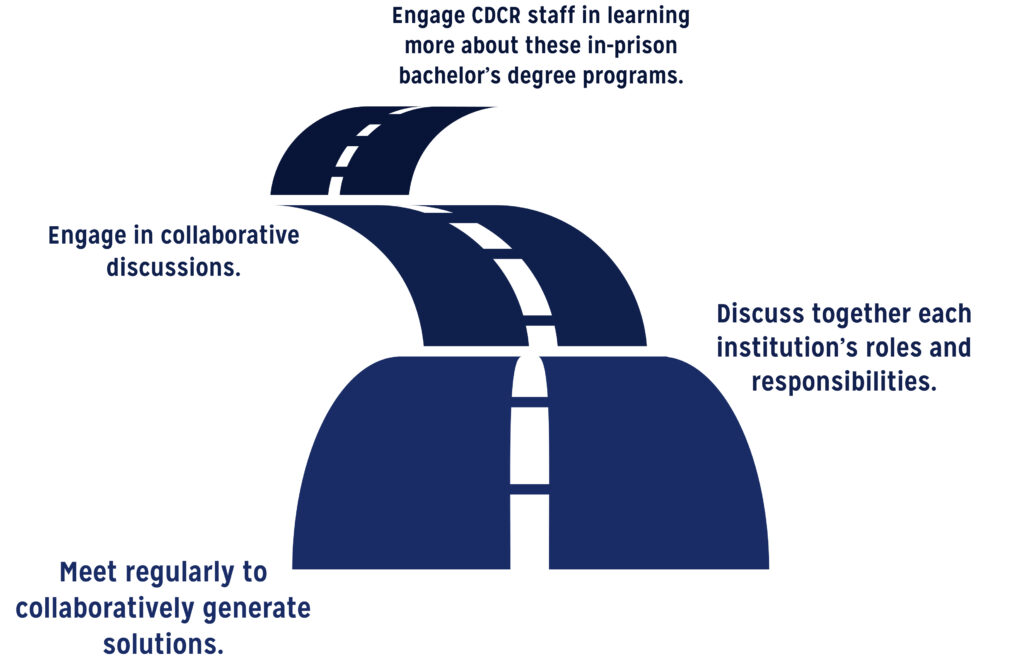
CSU personnel could consider strategies for garnering support or buy-in from frontline prison staff. First, CSU personnel can engage CDCR staff in learning more about these in-prison bachelor’s degree programs to support their understanding of the benefits of such programs beyond the individual student’s experience. Next, CSU and CDCR personnel could engage in collaborative discussions about how these programs may affect correctional officers’ job duties and discuss together each institution’s roles and responsibilities related to these programs to identify areas where responsibility may be shared. Finally, CSU personnel and CDCR staff could meet regularly to collaboratively generate solutions to implementation challenges that are practical and feasible. As these programs continue to evolve and develop within the prison, CSU personnel can consider ways to leverage early supporters in messaging these programs to fellow correctional staff.
Allocating Funds to Sustain Programs
Sustained and dedicated funding is essential to maintaining staffing that can appropriately respond to the needs of a growing program. In its absence, efforts related to in-prison programs and support provided by Project Rebound can often spill over into staff’s own time and resources. Several strategies for securing dedicated program funding shared by CSU personnel included:
- engaging in fundraising to secure multiple streams of funding through assorted grants and philanthropic dollars; and
- advocating to state legislators and partnering with CDCR administrators to direct state dollars to in-prison bachelor’s degree programs.
There needs to be a statewide conversation that says the CSU is running these programs, because we believe that this is the most marginalized population in the state of California.…. [going] into prisons and [teaching] incarcerated people epitomizes the commitment that the CSU has, but that commitment needs to be formalized in the budget. Just as the state budget has recognized the worth of project rebound, the state budget needs to recognize the worth of these BA programs and name them and allocate them.
—Communications Professor
Maintaining Adequate and Consistent Staffing
The logistical requirements for teaching in prisons, such as the time and cost associated with traveling to one or more prisons to teach, going through the security check process, and having course materials submitted, reviewed, and changed to address concerns or restrictions, are often unaccounted for when considering the cost to faculty who teach in these programs. Without factoring these elements into a faculty’s loads, they may be more at risk for burn out, which erodes consistency in staffing and can negatively impact the longevity of such programs.
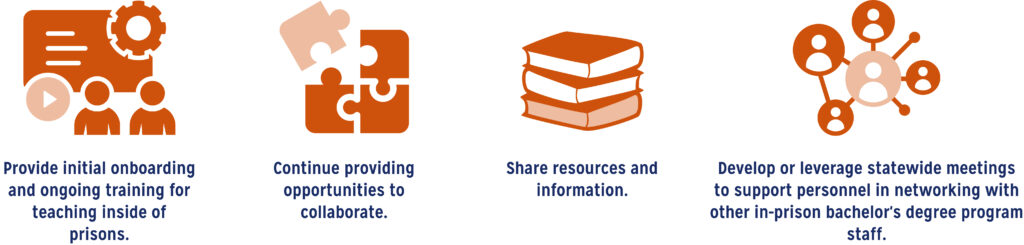
Sustaining human capital also means maintaining support for those who work in the in-prison bachelor’s degree programs. Interviewees discussed the importance of ensuring peer-to-peer support, both within and across institutions, for faculty teaching inside prisons. Within one’s institution, support could be provided through initial onboarding to teaching inside of prisons (e.g., logistics, challenges, restrictions or limitations, tailored handbook or resources); ongoing training (e.g., evidence-based practices, strategies); and continued opportunities to collaborate with and learn from colleagues (e.g., collaborative brainstorming, problem-solving, advice).
As the number of colleagues across educational sectors and institutions operating in-prison bachelor’s degree programs continues to grow throughout the state, practitioners have more colleagues to look toward for collaboration or support. CSU personnel highlighted how the systemic sharing of resources, information, and networking with other in-prison bachelor’s degree program personnel statewide could support them in driving forward program improvements. Moreover, developing or leveraging statewide meetings to ensure ongoing opportunities for coordination, collaboration, and learning can continue providing staff, faculty, and administrators with opportunities to share strategies for furthering support to currently and formerly incarcerated students.
Expanding Roles or Responsibilities to Facilitate Seamless Navigation of Support and Services Following Prison
Coordinating and streamlining courses and degree pathways are not only essential for students to make timely and effective academic progress while incarcerated, but also for continuing their education following their release from prison. CSU personnel shared a number of barriers that students encounter when coming home. Through these interviews, personnel recounted that students may be released to a part of the state that is different from where they were in prison; meaning, they would potentially need to enroll in an entirely different university to continue progressing towards their degree. Potentially, courses required at the new institution could be different from those the student has already taken for a similar degree, resulting in additional steps before the student can enroll in the university. Moreover, formerly incarcerated students may experience barriers to academic progress due to administrative processes (e.g., restricted course offerings in prisons). Without exceptions from the university receiving the formerly incarcerated student, the student may encounter further delays in making academic progress.
Coordinating Holistic Services and Supports
Faculty who teach inside of prisons may find themselves providing students with support that goes beyond the classroom and course materials as CSU staff, faculty, and administrators may be involved in helping students prepare for or navigate parole. Practitioners may be positioned to provide resources to students to support their academic progress after their release from prison (e.g., list of Project Rebound offices and contact information, information for local and support agencies and services) and write letters of support for parole hearings. These responsibilities are not accounted for in CSU personnel’s job duties and are therefore conducted in addition to their daily tasks and without explicit training around the process and expectations for providing parole support.
It is important to determine first whether CSU staff, faculty, or administrators have a role in or a responsibility to support currently incarcerated students in preparing for parole: CSU and CDCR personnel, including both leadership and frontline staff, should collaborate to develop a plan for how this information and ongoing support should be facilitated and by whom. If CSU personnel are tasked with providing parole support, in-prison bachelor’s degree program administrators should consider:
- establishing and communicating expectations for providing parole support with CSU and CDCR personnel to ensure shared understanding across institutions and individuals who interact with currently incarcerated students;
- creating a process for developing, maintaining, and updating resources to support parole preparation (e.g., contact list and information);
- making a plan and process for sharing these resources with CDCR personnel and currently incarcerated students; and
- developing and facilitating training for any CSU staff, faculty, or administrators who may be positioned to provide parole support to currently incarcerated students.
One strategy for effectively supporting students’ transitions from one institution to the next is to provide a warm handoff by connecting the student to a specific individual at the next institution. Postsecondary institutions across education sectors and community organizations and agencies that engage with and support formerly incarcerated students could consider establishing a reentry coordinator to be the dedicated point of contact for formerly incarcerated students. Having an explicit coordinator role can make the students’ connection to on- and off-campus support more direct and seamless.
Allowing for Flexibility and Creative Problem-Solving
Justice-involved students encounter barriers to making timely degree progress because of uncoordinated course offerings and degree pathways, which is detailed more extensively in the Collaborating Across Institutions to Support Justice-Involved Students blog, and physical barriers to accessing learning. Physical restrictions, such as a lockdown or lack of classroom space, can prevent incarcerated students’ access to education. The expansion of technology has furthered students’ access to coursework in the wake of these physical restrictions. Courses that are live-streamed or hybrid create opportunities for currently incarcerated individuals to engage in virtual learning which can allow for more students and students from harder to reach geographic areas to have access to college coursework. Moreover, the ability to use laptops and technology to complete coursework can provide students with the opportunity to continue their learning while in their cells, reducing the impact of barriers to accessing physical learning spaces.
Institutional responses to address the barriers to educational progress from uncoordinated course offerings and pathways and physical restrictions are specific to the particular institution. This can result in uneven support for justice-involved students that is entirely dependent on the prison and university that they are in. Systematizing solutions could further students’ academic opportunities and success regardless of the institutions a student may encounter. To systemize solutions that respond to these barriers, prison and university personnel could work collaboratively to:
- identify the restrictions to continuing one’s educational journey that are created or furthered by institutional policies to better understand with which agencies the solution may sit;
- understand the exceptions that are being made at institutions to overcome the identified barriers; and
- identify opportunities for systematizing solutions so they move from case-by-case to being recognized as practice across the state.
Summary
It is evident that access to postsecondary education has expanded for incarcerated students throughout California, though challenges with developing and sustaining in-prison bachelor’s degree programs persist. Structural and social barriers can limit and negatively impact both the success of these programs and students’ overall academic progress and outcomes. Rather than exploring the logistical elements of designing, implementing, and expanding in-prison bachelor’s degree programs, practitioners often discussed the critical role of collaboration and coordination within and across postsecondary institutions and prisons in ensuring a smooth educational pathway for currently and formerly incarcerated students. Practitioners provided actionable suggestions for deepening the commitment to in-prison bachelor’s degree programs through funding and collective responsibility, sustaining human capital to maintain and evolve these programs through dedicated resources and ongoing training, clarifying roles and responsibilities across institutions to ensure these programs operate as intended, and engaging in collaborative learning, support, and problem-solving to ensure these programs are designed in ways that are effective, flexible, and feasible. Across these conversations with CSU practitioners, one thing is clear: currently and formerly incarcerated students’ access to and support through their educational journeys will be impacted by the existence and strength of relationships within and across institutions as well as the extent to which courses, programs, and resources are coordinated and aligned across institutions. It is not enough to simply provide currently incarcerated students with access to courses. To further equitable academic access and success, currently and formerly incarcerated students need to be provided with academic pathways that will result in transfer and degree attainment as well as with the relevant supports that respond to their lived experiences and challenges.
It is not enough to simply provide currently incarcerated students with access to courses.